
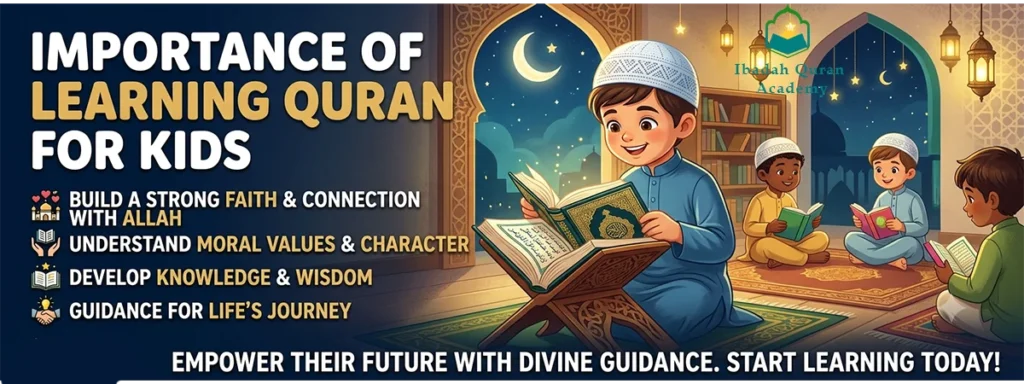
Importance of Learning Quran for Kids: Benefits, Methodology & How to Get Started
The importance of learning Quran for kids goes far beyond memorising verses; it shapes a child’s character, faith, and outlook on life from the earliest years. Parents across the UK, USA, Canada, Australia, and Pakistan are recognising the benefits of learning Quran for kids as an essential part of raising confident, grounded children. Understanding why children should learn Quran early helps families make informed decisions about their child’s Islamic upbringing.
At Ibadah Quran Academy, we have seen how learning Quran for children transforms daily habits, speech, and behaviour when introduced with patience and the right teaching approach. This guide explains the real benefits tied to the importance of learning Quran for kids, the right starting age, and how to build a Quran learning routine your child will genuinely enjoy, supported by Quran education for kids that feels natural rather than forced.
Why Learning Quran Matters for Every Child’s Development
The importance of learning the Quran for kids becomes clear when we look at development beyond religious ritual alone. Every child benefits when Quran learning becomes part of their early routine, not just spiritually but emotionally and mentally as well. The spiritual benefits of the Quran for children appear in small daily moments, such as calmer reactions to frustration and a stronger sense of purpose. Because these effects build gradually, consistency matters more than intensity, and even short daily sessions create meaningful, lasting development.
What Are the Spiritual and Emotional Benefits of the Quran for Children?
Children who engage with the Quran regularly often show greater emotional steadiness, especially during stressful moments like exams or family changes. The spiritual benefits of the Quran for children include a growing sense of connection to Allah, which many parents describe as a quiet confidence in their child’s demeanour. Reciting familiar surahs before bed or after school can become a comforting ritual. Over time, this consistency nurtures gratitude, patience, and a genuine love for worship rather than obligation.
How Does Quran Learning Support Moral and Character Building in Kids?
Moral development through the Quran happens naturally as children absorb stories of the Prophets and their lessons on honesty, patience, and kindness. This is where Quran and character building in kids become visible in everyday choices, such as sharing, apologising, or telling the truth without being asked. Unlike abstract moral lessons, Quranic stories give children relatable examples they can apply immediately. As a result, many parents notice improved behaviour at home and school within months of consistent learning.
Quran, Memory, and Brain Development: What Does Research Say?
Early Quran learning and brain development are closely linked, as memorisation exercises strengthen recall, focus, and listening skills from a young age.[1] Researchers studying memorisation-heavy learning note that children trained in structured recitation often show Quran and memory improvement for kids that extends into general academic memory tasks. For example, a child memorising Surah Al-Mulk gradually builds the mental discipline needed for retaining longer passages elsewhere. This cognitive training happens gently, without added academic pressure.
How Quran Education Shapes a Child’s Life Beyond Religion
Beyond ritual worship, Quran learning shapes how children think, behave, and perform across every part of daily life. Parents often ask about Quran and academic performance, wondering if structured recitation training pulls focus from school subjects; in practice, it tends to reinforce concentration instead. Children who memorise regularly develop stronger listening comprehension and attention spans, both of which transfer directly into classroom learning. In addition, the calm routine built around Quran study often improves sleep and reduces evening screen time.
Quran and Academic Performance — Is There a Real Connection?
Quran and academic performance are connected mainly through the discipline of daily practice rather than direct subject overlap. Children who memorise verses build listening stamina, which helps them follow longer classroom instructions without losing focus. Therefore, teachers sometimes notice that Quran students settle into new material faster than peers without a memorisation routine. This is not a guarantee of higher grades, but the study habits transfer well.
How Quran Recitation Promotes Mental Peace and Reduces Anxiety in Kids
Quran recitation for children’s mental peace works because the rhythmic pattern of Tajweed naturally slows breathing and settles restless thoughts.[2] Many parents introduce a short recitation session before bedtime or after a difficult school day, and children respond with visibly calmer moods. For example, reciting Surah Al-Fatiha slowly can become a grounding habit during exam season. Over weeks, this reduces general anxiety and builds a healthy coping tool for life.
Building Good Manners and Islamic Values Through Daily Quran Practice
Quran and good manners in children grow together because verses on kindness, honesty, and respect are reinforced daily, not just taught once. This consistent exposure supports Quran and Islamic values for kids, helping children understand why good behaviour matters rather than simply following rules. For instance, a child learning about patience in Surah Al-Asr may apply it directly during a sibling disagreement. These small, repeated lessons build values that outlast any single class.
The Right Age and Method to Start Quran Learning
Understanding the importance of learning the Quran for kids also comes down to timing. Choosing the right age to start learning Quran depends on a child’s attention span and comfort with a structured routine rather than a fixed number. Most children respond well between ages four and seven, when curiosity is high, and habits form easily. However, older children can also start confidently if the teaching pace matches their existing academic workload. What matters most is starting with short, encouraging sessions instead of long, pressured ones.
What Is the Ideal Age to Start Quran Learning for Kids?
Many scholars and educators recommend that children learn the Quran at a young age, typically between four and six, when memory retention is naturally strong. Starting early also builds familiarity with Arabic sounds before school workloads increase. That said, the right age to start learning Quran always depends on the individual child’s readiness rather than pressure from comparison with siblings or peers. A relaxed, playful introduction works better than a rigid start date.
Quran Memorization vs. Tajweed-Focused Learning — Which Comes First?
Quran memorization for kids and Tajweed rules often develop side by side rather than in strict sequence. Learning Quran with Tajweed for children early helps avoid pronunciation habits that are harder to correct later. Meanwhile, Tajweed learning for kids paired with short memorisation goals keeps sessions engaging instead of repetitive. In practice, a balanced approach that blends both from the start produces more confident, accurate reciters over time.
How to Make Kids Love Learning Quran (Without Pressure)
Building love for the Quran in kids starts with making sessions short, encouraging, and free of comparison with other children. Praise for effort, not just accuracy, keeps motivation high during the early, mistake-heavy stage of learning. For example, celebrating a correctly recited verse with genuine enthusiasm builds more enthusiasm than correcting every small error immediately. When children associate Quran time with warmth rather than pressure, they return to it willingly.
What Makes a Quran Program Trustworthy and Effective for Kids
This is where the importance of learning Quran for kids becomes measurable, not just theoretical. Trustworthy online Quran classes for kids rely on qualified teachers, structured curricula, and transparent communication with parents at every stage. A genuinely effective programme tracks progress consistently, so parents can see measurable growth rather than vague reassurances. At Ibadah Quran Academy, we build our teaching structure around these exact expectations.
Certified Tajweed Instructors and Their Role in a Child’s Learning Journey
This is central to the importance of learning Quran for kids because instructor quality shapes outcomes more than any curriculum on paper. Certified instructors bring more than technical knowledge; they shape a child’s confidence through patient, structured Islamic education for kids. A qualified teacher corrects pronunciation gently, without discouraging a nervous beginner from continuing. This blend of subject expertise and teaching sensitivity is what separates a rushed class from genuine progress.
How Progress Tracking and Assessments Keep Kids Motivated and Accountable
Regular assessments highlight the benefits of memorizing the Quran for children by showing clear, visible milestones rather than abstract progress. Weekly progress reports help parents understand exactly which surahs, rules, or memorisation targets their child has mastered. Therefore, children stay motivated when they can see their own growth charted over weeks and months. This transparency also helps parents adjust pace or support at home when needed.
Safety Standards and Parent Involvement in Online Quran Classes for Kids
Online Quran classes for kids always include recorded sessions, verified teacher identities, and easy parent access to class history. This transparency reassures parents who are naturally cautious about their child’s online learning environment. In addition, allowing parents to sit in on early classes builds trust before stepping back into a more independent routine. Safety and openness, together, form the foundation of a program parents feel confident recommending.
Addressing Parents’ Top Concerns About Online Quran Classes for Kids
Parents new to Islamic education for kids delivered online often worry about engagement, discipline, and whether a screen-based class can hold a child’s attention. In practice, one-on-one sessions with an experienced teacher tend to keep children more focused than group classroom settings. However, consistency at home, including a quiet learning space and a regular schedule, plays an equally important role. Addressing these concerns early helps parents commit confidently to a long-term learning plan.
Is Online Quran Learning as Effective as In-Person Classes?
Well-structured online Quran classes for kids can match, and sometimes exceed, in-person results because of the individual attention one-on-one video sessions allow. A teacher can immediately correct a mispronounced letter without waiting for turns, unlike in a shared physical classroom. For example, children in one-on-one online sessions often complete Tajweed milestones faster than in larger group settings. This is the practical proof behind the importance of learning the Quran for kids in a connected world.
How Do You Keep a Child Consistent and Motivated Long-Term?
Consistency comes from treating Quran learning as part of daily Quran guidance for kids’ daily life, not a separate, occasional task. Setting a fixed time each day, even just fifteen minutes, builds a habit that survives busy weeks. Therefore, families who protect this daily slot see far steadier long-term progress than those who study only when convenient. Small, repeated wins matter more than occasional long sessions.
What Results Should Parents Expect After 3, 6, and 12 Months?
Within three months, most children show improved pronunciation and comfort reciting familiar short surahs confidently. By six months, Quran and protection from bad influences become more visible, as children begin applying learned values to real situations like honesty and patience. After twelve months, steady memorisation progress and noticeably improved Tajweed accuracy are common outcomes. These timelines vary by child, but consistent effort reliably produces visible growth.
Start Your Child’s Quran Learning Journey Today
Choosing when to begin is often harder than the learning itself, but a free trial class removes most of that hesitation. At Ibadah Quran Academy, we encourage every family to observe a live session before committing, so there are no surprises about teaching style or pace. This transparent first step reflects the same Islamic education for kids standards we apply throughout every stage of a child’s learning journey. Starting today simply means taking that first, low-pressure look.
Book a Free Trial Class and See the Teaching Style Firsthand
A free trial class lets parents watch how a teacher interacts with their child in real time, without any commitment. This firsthand view matters more than any brochure description of Islamic education, because teaching chemistry is personal. For example, some children respond better to a gentle, slow-paced teacher, while others thrive with more structured correction. Observing this directly helps parents choose confidently.
How to Choose the Right Quran Program for Your Child’s Goals
The right programme depends on whether your priority is memorisation, Tajweed accuracy, or a balance of both aligned with Quran and Islamic values for kids. Parents should ask about teacher qualifications, class recording policies, and how progress is measured before enrolling. In addition, flexible scheduling matters for families juggling school and extracurricular commitments across different time zones. Matching these priorities to a programme’s structure leads to a better long-term fit.
What to Expect: Quran Learning Milestones
The table below summarises realistic outcomes parents can expect at each stage, reinforcing the importance of learning Quran for kids as a gradual, consistent process rather than a quick fix.
| Timeframe | Typical Progress | Skill Developed |
| 3 Months | Confident recitation of familiar short surahs | Pronunciation & basic Tajweed |
| 6 Months | Applying Quranic values in daily behaviour | Moral awareness & self-control |
| 12 Months | Steady memorisation with accurate Tajweed | Memory retention & discipline |
Conclusion
The importance of learning Quran for kids extends well beyond religious duty; it shapes character, calm, memory, and daily behaviour in ways that last a lifetime. Families across the UK, USA, Canada, Australia, and Pakistan are choosing structured, trustworthy programmes precisely because the benefits of learning Quran for kids are so far-reaching. At Ibadah Quran Academy, we remain committed to guiding every child through this journey with patience, qualified teachers, and transparent progress tracking. Book a free trial class today and see the difference firsthand.
Why is it important for children to learn the Quran?
The importance of learning Quran for kids lies in building strong moral character, mental discipline, and a lifelong spiritual connection from an early age.
At what age should a child start learning the Quran?
Most educators recommend starting between ages four and seven, though the right age to start learning Quran always depends on each child’s readiness.
How can I make Quran learning interesting for my child?
Keep sessions short, celebrate small wins, and avoid comparison. Building love for the Quran in kids works best through patience, not pressure.
What are the benefits of learning the Quran for kids?
Benefits include improved memory, emotional calm, stronger moral character, better focus in school, and lasting Islamic values learned through daily practice.