
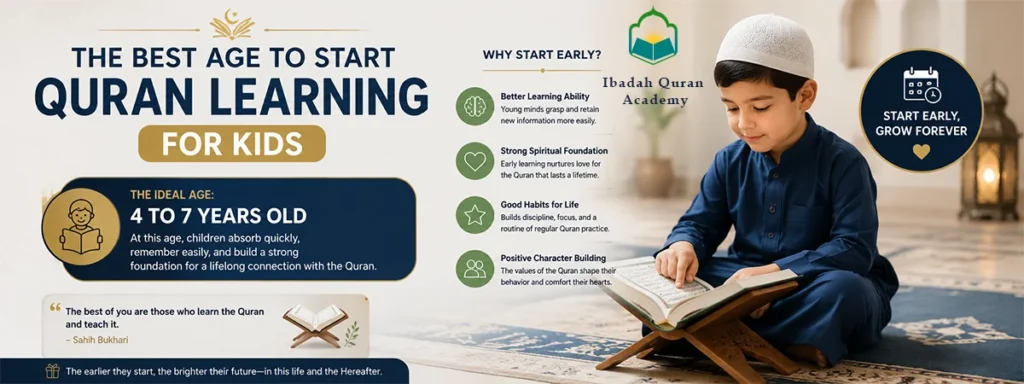
Best Age to Start Quran Learning for Kids: A Complete Parent’s Guide
Every parent asks the same question: What is the best age to start Quran learning for kids? The answer matters more than most realise — begin too early without the right method and a child may lose interest; begin too late and precious years of language acquisition are missed. The good news is that Quran education for children does not follow a single rigid timeline. With the right teaching approach, children as young as three can begin their journey, while others thrive when they start at five or seven.
This guide draws on Islamic educational principles, early childhood development research, and years of structured teaching experience. Whether you are exploring Online Quran classes for kids for the first time or looking to switch to a more structured programme, you will find clear, age-by-age guidance here. We will also show you how Ibadah Quran Academy supports every child at their own Quran learning pace — from the first Arabic letter to confident, melodic recitation.
What Is the Best Age to Start Quran Learning for Kids?
The ideal age to learn Quran depends on a child’s readiness, not just their birthday. Most Islamic scholars and early childhood educators agree that the best age to start Quran learning for kids is between four and seven years. This window aligns with key milestones in language acquisition, phonetic awareness, and memory formation.
However, readiness matters more than age alone. A curious three-year-old who loves listening to recitation may be more prepared than a hesitant six-year-old. Understanding both child development and Quran learning helps parents make a confident, informed choice.
Why Early Quran Education Shapes a Child’s Faith Foundation
Research in early childhood development consistently shows that children absorb language patterns most effectively between ages two and seven — a period neuroscientists call the critical window for language acquisition. Starting early Quran education during this phase means children internalise Arabic sounds naturally, much like a mother tongue.
Beyond linguistics, teaching Quran to kids early builds a lifelong faith foundation. Children who hear and repeat Quranic verses regularly develop a deep emotional connection to worship, prayer, and Islamic identity. The Prophet Muhammad (PBUH) emphasised teaching children Surah Al-Fatiha and short surahs from a young age — a Sunnah that reflects both spiritual wisdom and educational insight.
Quran Learning Milestones by Age: What to Expect at Each Stage
Understanding Quran learning milestones by age helps parents set realistic expectations. Below is a simple reference — detailed in the table further below — covering what children typically achieve at each stage when taught consistently with qualified guidance.
- Ages 3–5: Listening, Arabic sounds, short duas, and nursery surahs
- Ages 5–7: Noorani Qaida letters, basic joining, and phonemic awareness
- Ages 7–10: Quran reading, Tajweed basics, and short surah memorisation
- Ages 10+: Advanced Tajweed, Hifz programme, and full surah memorisation
Reading Readiness in Quran Education: Signs Your Child Is Ready
Before enrolling a child in formal children’s Quran classes, look for these signs of Quran reading readiness:
- They can sit and focus for ten to fifteen minutes
- They recognise and repeat sounds they hear
- They show curiosity about the Quran, prayer, or Arabic
- They can follow simple two-step instructions
- They enjoy repetitive learning activities (rhymes, stories)
If your child shows most of these signs, they are ready to start Quran education early — even if they are only four years old. Our qualified teachers at Ibadah Quran Academy assess each child individually before placing them in the right programme.
Age-by-Age Breakdown: When to Begin Each Stage of Quran Education
Understanding the right age to start Quran classes for children is easier when you see the full picture. Below is a detailed age-by-age guide followed by a structured reference table covering Quran learning milestones by age, so parents can plan confidently.
Ages 3–5: Listening to Quran and Learning the Arabic Alphabet
The earliest stage of Quran learning for young children is not about reading — it is about listening. Between ages three and five, children develop their phonemic awareness primarily through repeated audio exposure. Playing Quran recitations at home, teaching short duas like Bismillah and Alhamdulillah, and introducing the Arabic alphabet for kids through songs and games is highly effective at this stage.
Formal one-to-one lessons of fifteen to twenty minutes can begin at age four for children who show readiness. The focus remains on hearing correct Arabic pronunciation, repeating short phrases, and building a love for Quranic recitation — not written exercises.
Ages 5–7: The Ideal Age to Start Noorani Qaida for Beginners
Most educators identify five to seven as the ideal age to start Noorani Qaida — the foundational textbook that teaches correct Arabic letter recognition, pronunciation, and joining. At this stage, children’s visual and phonetic processing skills are sufficiently developed to begin structured learning.
Noorani Qaida Classes for Kids introduce each Arabic letter with its three vowel forms, then progress through joined letters, heavy and light letters, and basic Tajweed patterns. Children who complete Noorani Qaida at this age are typically ready to begin reading the Quran by age seven or eight — a strong foundation for lifelong Quran recitation for children.
Ages 7–10: When to Begin Tajweed Basics and Short Surahs for Kids
Between seven and ten, children are cognitively ready for Tajweed basics for children. This is when formal rules of recitation — such as Madd, Ghunnah, and Idgham — are introduced systematically. Children at this stage also begin memorising short surahs for kids, typically starting from Surah Al-Nas and working backward through Juz Amma.
This age group benefits greatly from structured weekly goals, interactive classes, and positive reinforcement. Our teachers use gamified progress tracking to keep seven-to ten-year-olds motivated and consistent, ensuring that Quran learning for beginners never becomes a chore.
Quran Learning Age Guide — Quick Reference
| Age Group | Quran Learning Stage | Key Focus | What to Expect |
| 3–5 Years | Listening & Arabic Sounds | Audio exposure, nursery duas | Familiarity with Quran rhythm |
| 5–7 Years | Noorani Qaida Beginner | Arabic alphabet recognition | Letter sounds, basic joining |
| 7–9 Years | Noorani Qaida Advanced | Word-level reading, vowels | Reads simple Arabic words |
| 9–11 Years | Quran Reading + Tajweed Intro | Short surahs, basic Tajweed | Reads fluently with rules |
| 11+ Years | Hifz / Advanced Tajweed | Memorisation, full Tajweed | Memorises Juz Amma & beyond |
How Certified Quran Teachers Support Every Child’s Learning Pace
One of the most common concerns parents share is this: “My child is slower than others — will they fall behind?” At Ibadah Quran Academy, the answer is a clear no. Every child progresses at their own Quran learning pace, and our certified teachers are trained to adapt lesson plans accordingly.
Age-Appropriate Quran Lessons Designed by Qualified Instructors
Our instructors design age-appropriate Quran lessons based on a child’s current level, attention span, and learning style — not simply their age. A five-year-old who has already completed half of Noorani Qaida will receive a lesson designed for their actual progress, not a generic template.
All teachers at Ibadah Quran Academy hold recognised Ijazah certification in Quran recitation and Tajweed. This means every Online Quran Classes for kids is delivered by someone with a verified, unbroken chain of transmission back to the Prophet Muhammad (PBUH) — the highest standard of authentic Islamic education.
How We Track Progress and Set Quran Learning Goals for Each Child
Progress tracking is built into every child’s Quran study at home journey with us. After each class, teachers update a detailed progress report accessible by parents. Goals are set collaboratively — for example, completing ten pages of Noorani Qaida in four weeks — and reviewed monthly.
Parents receive regular feedback covering pronunciation accuracy, memorisation retention, Tajweed application, and overall engagement. This transparency builds trust, helps parents reinforce learning at home, and ensures that beginner Quran courses for kids always have a clear direction.
What Parents Say: Real Results from Our Children’s Quran Classes
“My daughter started at age five with absolutely no Arabic knowledge. Within eight months, she completed Noorani Qaida and began reading the Quran. The teacher was patient, consistent, and genuinely cared about her progress.” — Parent, UK
“We tried two other academies before Ibadah. The difference is clear — structured lessons, qualified teachers, and my son actually looks forward to every class.” — Parent, USA
“As a non-Arabic-speaking family, we needed someone who could make Quran learning for children accessible. Our daughter now recites Surah Al-Mulk confidently. We couldn’t be happier.” — Parent, Canada
What Our Beginner Quran Programme Covers at Ibadah Quran Academy
The best age to start Quran learning for kids is only the beginning. What matters just as much is how that learning is structured. Our beginner programme at Ibadah Quran Academy is designed around a gradual Quran learning path that takes children from their very first Arabic sound to confident Quranic recitation — step by step, never rushed.
From Arabic Pronunciation to Quran Recitation: Our Gradual Learning Path
Learning to recite the Quran begins with mastering the pronunciation of Arabic letters. Our curriculum follows a proven sequence: Arabic phonetics → Noorani Qaida → connected words → Quran verses → short surahs → full Quran reading with Tajweed.
Each stage builds directly on the previous one, meaning no child is ever pushed forward before they are truly ready. This gradual Quran learning approach prevents the most common problem in Quran education: children who can recite quickly but without accuracy or understanding of pronunciation rules.
Noorani Qaida, Tajweed, and Quran Memorisation — Structured by Age
Noorani Qaida Course is the first structured milestone, typically completed between the ages of five and eight. Once a child reads Noorani Qaida confidently, they move on to Quran reading with basic Tajweed application. Formal Tajweed basics for children — including rules like Noon Sakinah, Tanween, and Madd — are introduced between the ages of seven and ten.
For families interested in Hifz, our Quran memorisation for children programme begins after a child demonstrates strong reading fluency. We typically recommend starting Hifz between ages eight and twelve — old enough for reliable memory retention, young enough to benefit from the brain’s peak memorisation capacity.
How Our Online Quran Classes for Kids Keep Children Motivated and Consistent
Consistency is the greatest challenge in Quran study at home. Children lose motivation when lessons feel repetitive or disconnected from their interests. Our teachers use a blend of interactive activities, reward milestones, recitation games, and regular parent check-ins to keep every child engaged.
Our learn Quran online for kids platform supports video-based one-to-one sessions with screen sharing for Qaida tracking, digital flashcards for Arabic letters, and recorded sessions parents can review. Children can join from any device — desktop, tablet, or smartphone — making Islamic education for children accessible wherever they are in the world.
Enrol Your Child Today and Start with a Free Trial Class
Starting your child’s Quranic journey has never been more straightforward. Whether your child is four years old and just discovering Arabic letters or nine years old and ready to begin formal Tajweed, Ibadah Quran Academy has a structured programme designed for their exact level. The best age to start Quran learning for kids is now — and our free trial class gives you a zero-risk opportunity to experience the quality difference for yourself.
How to Choose the Right Programme Based on Your Child’s Age and Level
Choosing the right age-appropriate Quran lessons begins with a simple assessment. During your child’s free trial class, our teacher will evaluate their current Arabic letter recognition, phonetic awareness, and attention span. Based on this, we will recommend one of our structured programmes:
- Pre-Qaida (Ages 3–5): Audio-based Quran exposure, Arabic letter introduction, short duas
- Noorani Qaida (Ages 5–8): Structured phonics-based Arabic reading with qualified instructors
- Quran Reading + Tajweed (Ages 7–11): Fluent Quran reading with applied Tajweed rules
- Hifz Programme (Ages 8+): Supervised Quran memorisation with weekly targets
Flexible Scheduling for Quran Study at Home — Morning, Evening, and Weekends
We understand that families in the UK, USA, Canada, Australia, and Pakistan have different schedules and time zones. That is why our Quran study at home timetable offers morning, afternoon, evening, and weekend Quran classes available five to seven days a week, with session lengths of thirty, forty-five, or sixty minutes depending on your child’s age and programme.
All classes are one-to-one — your child receives the teacher’s undivided attention during every session, which research consistently shows produces faster progress than group classes for Quran learning for beginners.
Book a Free Trial Class and See the Difference Qualified Teaching Makes
Ready to see results? Book your child’s free trial class today with no commitment required. You will meet a certified Quran teacher, observe the lesson structure in action, and receive an honest assessment of your child’s current level and the right next steps.
📞 Book Your Free Trial Class Now — no commitment required
Thousands of Muslim families across the UK, USA, Canada, Australia, and Pakistan have already taken this first step. Join them and discover what happens when Quran learning for children is guided by real expertise, genuine care, and a curriculum built around your child’s natural learning pace.
At what age should a child start learning the Quran?
Most children can begin learning Quran between the ages of four and seven. Children as young as three can start with listening and Arabic letter exposure. Formal reading typically begins at five to six, depending on the child’s individual readiness and attention span.
What is the best age for Quran learning?
The best age to start Quran learning for kids is five to seven years. This window aligns with peak phonetic development and memory formation. However, readiness matters more than age — a focused four-year-old can begin Noorani Qaida successfully.
Is 4 years old too early for Quran classes?
No. Age four is an excellent time for early Quran education — especially listening-based and phonics-focused sessions. Short daily sessions of ten to fifteen minutes with a patient teacher produce strong results at this age.
Can children start Quran at age 5 or 6?
Absolutely. Five to six is considered the ideal age to learn the Quran. At this stage, children can begin Noorani Qaida, recognise Arabic letters, and develop correct pronunciation habits that will support fluent recitation for life.
How to introduce the Quran to toddlers?
Play Quran recitation during daily routines, teach Bismillah before meals, and use Arabic alphabet songs and rhymes. Quran learning for young children at toddler age is about building love and familiarity — not formal instruction.
What age is best for Noorani Qaida?
The age to start Noorani Qaida is typically five to seven years. Children at this age can recognise letter shapes, process phonetic differences, and begin joining Arabic letters — the core skills Noorani Qaida builds.