
What Is Tajweed in Quran — A Complete Beginner’s Guide to Quran Recitation Rules
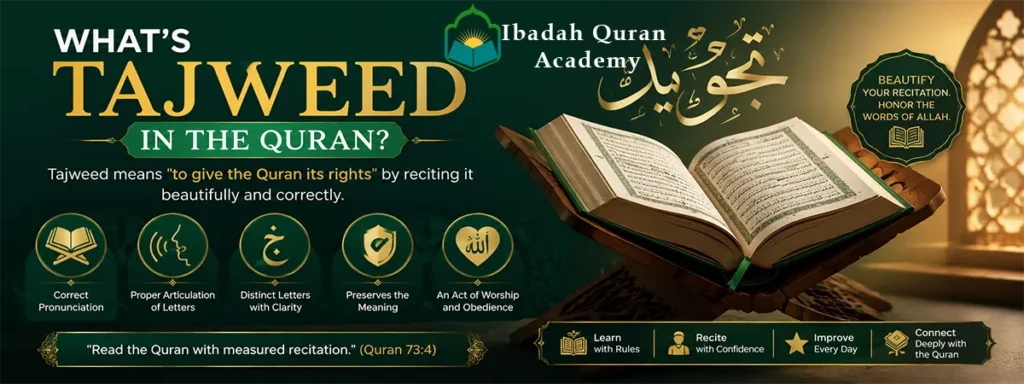
If you have ever wondered what is Tajweed in Quran, you are not alone. Millions of Muslims across the UK, USA, Canada, Australia, and Pakistan ask this very question every year. Tajweed in Quran is the set of rules that governs how every Arabic letter is correctly pronounced during recitation. It ensures that the words of Allah (SWT) are delivered with the precision, beauty, and accuracy they deserve. Without it, even a minor mispronunciation can alter meaning — and in the Quran, every word carries weight.
This guide explains everything you need to know about what is Tajweed in Quran: the definition, the key Tajweed rules, how long it takes to learn Tajweed, what to look for in a qualified teacher, and how to get started online. Whether you are a complete beginner or looking to refine your Quran recitation rules, this is your complete reference. At Ibadah Quran Academy, our certified instructors have helped thousands of students master Tajweed in the Quran — and we would love to help you too.
What Is Tajweed in Quran and Why Does It Matter for Every Muslim?
To answer the question of what is Tajweed in Quran properly, we must look at both its linguistic meaning and its Islamic significance. What is Tajweed in Quran in everyday terms? It is the complete science of Quranic recitation. Quran recitation rules are not optional extras — they form the foundation of correct and valid recitation. Without this foundation, both meaning and spiritual reward may be affected.
The Linguistic and Islamic Definition of Tajweed Explained
The word Tajweed comes from the Arabic root jawwada (جوّد), meaning to make something excellent or to improve. When people ask what is Tajweed in Quran from a linguistic angle, the answer lies in this root. In the context of the Quran, Tajweed refers to the science of applying the correct rules of pronunciation to each Arabic letter as the Prophet Muhammad (PBUH) recited it. It covers correct Quran pronunciation, the articulation of sounds, and the characteristics of each letter. Scholars define it as giving every letter its right (haqq) and its due (mustahaqq) — meaning its proper sound and its applied attributes.
What Happens When the Quran Is Recited Without Tajweed?
Reciting the Quran without proper Tajweed pronunciation can lead to what scholars call al-lahn — recitation errors. There are two types: al-lahn al-jali (clear mistakes that change meaning, which are haram) and al-lahn al-khafi (subtle errors that affect beauty and correctness). For example, confusing the Makhraj of letters can turn one word into another with a completely different meaning. This is why mastering the accurate pronunciation of Quran words is an Islamic duty, not merely an academic pursuit.
Is Learning Tajweed Fard (Obligatory) or Recommended?
Those asking what is Tajweed in Quran from an obligation standpoint will find that the majority of Islamic scholars agree that learning enough Quran Tajweed to recite correctly is fard ayn — individually obligatory on every Muslim who recites the Quran. The evidence comes from Surah Al-Muzzammil (73:4): “And recite the Quran with measured recitation (tarteel).” Therefore, avoiding mistakes in recitation is an act of worship, and learning to do so is an obligation rather than an optional refinement.
The Core Rules of Tajweed Every Learner Must Understand
Once you understand what is Tajweed in Quran at a conceptual level, the next step is to study its rules in practice. The rules of Quran Tajweed can be grouped into several categories. Together, they cover every aspect of Arabic letter pronunciation and recitation flow. The table below gives an overview of the most important rules every learner encounters.
| Tajweed Rule | Definition | Measurement | Purpose |
|---|---|---|---|
| Ghunnah | Nasal sound on Noon & Meem | 2 counts / 1 count | Softens recitation rhythm |
| Madd | Elongation of vowel sounds | 2–6 counts | Prevents meaning distortion |
| Qalqalah | Echo bounce on 5 letters (ق ط ب ج د) | Short bounce | Clarifies heavy letters |
| Idgham | Merging Noon Saakin into next letter | With/without Ghunnah | Smooth letter transition |
| Ikhfa | Partial hiding of Noon Saakin | Mid-nasal sound | Balanced pronunciation |
| Iqlab | Converting Noon Saakin to Meem sound | Before letter ب | Accurate articulation |
| Tafkheem | Heavy pronunciation of specific letters | Letters of استعلاء | Depth and fullness in sound |
| Tarqeeq | Light pronunciation of certain letters | Most Arabic letters | Clarity and lightness |
Makharij al-Huruf — Articulation Points and Why They Shape Every Letter
Makharij al-Huruf refers to the specific exit points — or articulation points in Arabic — from which each Arabic letter is produced. There are 17 primary articulation zones across the mouth, throat, tongue, lips, and nasal cavity. If a letter is produced from the wrong Makhraj, it will sound like a different letter entirely. For example, the letters Seen (س), Saad (ص), and Thaa (ث) are all sibilants, but each emerges from a distinct point. Mastering Quran phonetics begins here — with understanding where each sound physically originates.
Ghunnah, Madd, Qalqalah, Idgham, and Ikhfa — What Each Rule Controls
These five rules cover the most commonly tested aspects of the Tajweed rules in any structured course. Ghunnah produces a nasal resonance through the nose when reciting Noon and Meem. Madd rules govern the elongation of vowel sounds — ranging from 2 counts (natural Madd) to 6 counts (Madd Lazim). Qalqalah is the slight echoing vibration on five specific letters (ق ط ب ج د) when they appear with a sukoon. Idgham involves merging the Noon Saakin or Tanween into the following letter, while Ikhfa partially conceals the Noon Saakin with a balanced nasal sound. Each rule has a direct effect on both beauty and accuracy.
How Waqf (Pausing) and Ibtida (Resuming) Affect the Meaning of Verses
Waqf (pausing) and Ibtida (resuming) are among the most overlooked yet most impactful elements of Quran recitation with Tajweed. Pausing in the wrong place can alter — or even reverse — the intended meaning of an ayah. For instance, pausing incorrectly in certain verses can make it appear as though the Quran attributes a partner to Allah, which is clearly unintended. Recitation improvement at an advanced level always involves the careful study of Waqf signs, which are marked throughout the Mushaf to guide the reciter.
How Long Does It Take to Learn Tajweed and What Does the Journey Look Like?
After learning what is Tajweed in Quran, the natural next question is: how long does it take to master? One of the most common questions from parents and adult learners is how long the Tajweed course for beginners journey realistically takes. The honest answer depends on your starting point, your consistency, and the quality of your teacher. However, there is a clear, well-established pathway that all serious students follow.
From Noorani Qaida to Full Tajweed — A Realistic Learning Progression
Students who understand what is Tajweed in Quran and want to begin learning it properly will find a clear starting point. Most beginners — especially children — start with Noorani Qaida, a structured primer that introduces Arabic harakat (vowel marks), letter recognition, and basic letter joining. After completing Noorani Qaida (typically 3–6 months), students move into formal Quran reading basics and then into applied Tajweed rule study. By the time a student completes their Tajweed programme, they can recite entire Surahs with confidence, correct pronunciation, and the full application of recitation rules — a transformation that takes learning Quran step by step to its natural conclusion.
Can Adults Learn Tajweed from Scratch, or Is It Only for Children?
Adults are absolutely capable of learning Tajweed from scratch — and many do so with excellent results. In fact, adult learners often progress faster in certain areas because they understand the logic behind rules more quickly. The key is a qualified teacher who understands how to adapt instruction for adult learners. At our academy, we offer dedicated Tajweed for adults programmes that start from the very beginning, including beginner Quran learning modules designed specifically for those who have never studied Arabic phonetics before.
How Online Tajweed Courses Structure Progress from Beginner to Ijazah Level
A well-designed online Tajweed classes programme moves through four key stages: (1) letter recognition and Arabic harakat, (2) rule introduction and application, (3) full recitation fluency, and (4) Ijazah assessment. Students receive a Tajweed Quran Course with certificate upon passing the evaluation phase. Those who pursue Ijazah receive a Sanad — a verified chain of transmission linking them directly to the Prophet (PBUH) through certified scholars. This is the gold standard of Quranic recitation qualification worldwide.
What to Look for in a Qualified Tajweed Teacher or Online Programme
Now that you understand what is Tajweed in Quran, choosing the right teacher is arguably more important than choosing the right course material. The quality of recitation improvement a student achieves is directly tied to the qualifications, methodology, and attentiveness of their instructor. Here is what genuinely matters when evaluating any Quran teacher online.
Why Ijazah-Certified Instructors Produce Better Outcomes for Students
An Ijazah-certified teacher has not only mastered Tajweed themselves — they have been formally authorised to teach it by a qualified scholar, who received the same authorisation from their teacher, tracing back through an unbroken chain to the Prophet (PBUH). This matters because Tajweed is an oral tradition. Reading rules from a textbook is insufficient. A certified teacher will hear, identify, and correct your specific pronunciation errors in real time — something no recording or app can replicate. The beautiful Quran recitation of students taught by Ijazah-certified teachers speaks for itself.
One-to-One vs Group Tajweed Classes — Which Delivers Faster Results?
One-to-one online quran classes with Tajweed consistently produce faster and more measurable results than group settings, particularly for pronunciation correction. In a group class, the teacher cannot give each student the individualised feedback needed to address their specific common Tajweed mistakes. However, for students on a tighter budget, small group sessions of 2–4 students can offer a reasonable balance between personalised attention and cost. At our academy, we strongly recommend one-to-one sessions for the first 3–6 months, after which group review sessions can supplement solo learning.
How Our Certified Teachers Track Your Progress and Personalise Every Lesson
At Ibadah Quran Academy, every student receives a personalised progress tracker updated after each session. Our teachers document which Tajweed rules have been introduced, which have been mastered, and which need reinforcement. Parents of younger students receive weekly progress summaries so they can support Tajweed for kids practice at home. This system of continuous assessment means no student is left behind, and every lesson builds directly on the last. Our Quran teacher online team is available across the UK, USA, Canada, and Australia time zones.
How to Start Learning Tajweed Online with Confidence at Ibadah Quran Academy
Starting your journey to truly master what is Tajweed in Quran has never been simpler or more accessible. Everything you have read in this guide about what is Tajweed in Quran — the rules, the obligations, the methodology — comes alive in a live class with a qualified teacher. Our programme is built around your schedule, your level, and your goals — with a zero-risk entry point through our free trial class.
What to Expect in Your Free Trial Tajweed Class
Many students who search for what is Tajweed in Quran arrive at our academy with curiosity but understandable hesitation. Our free trial class is designed to remove that hesitation completely. It is a fully live, one-to-one session with one of our qualified teachers — not a sales call. During the session, your teacher will assess your current Quran recitation rules knowledge, identify your starting level, and recommend the right programme for you. Whether you are a complete beginner who has never studied Quran Tajweed or someone looking to refine existing skills, the trial gives you a direct experience of how our teaching works — before you make any commitment.
🎁 Book your free trial class today — no payment required, no pressure to enrol.
Which Tajweed Programme Is Right for You — Children, Adults, or Sisters-Only?
We offer three core tracks: Tajweed for kids (ages 5–16), Tajweed for adults (17+), and a dedicated sisters-only programme with qualified female teachers. Each track follows the same rigorous curriculum — Noorani Qaida foundation, applied Tajweed rules, full recitation proficiency, and an optional Tajweed Quran Course with a certificate. Our flexible scheduling covers morning, afternoon, and evening slots to suit students in the UK, USA, Canada, and Australia.
At Ibadah Quran Academy, we believe every Muslim deserves access to high-quality, certified Tajweed teaching — wherever they are in the world. Our programme is built on scholarship, trust, and a genuine commitment to your recitation improvement.
What is Tajweed in Quran in simple words?
Tajweed in Quran is the science of reciting the Quran with correct pronunciation, proper articulation of each Arabic letter, and accurate application of recitation rules so that no change in meaning occurs.
How long does it take to learn Tajweed?
Basic Tajweed rules can be learnt in 3–6 months with consistent lessons. Full proficiency to recitation standard takes 1–2 years. Earning Ijazah certification may require 2–4 years of guided study.
What technology is needed for online Tajweed classes?
A smartphone, tablet, or laptop with a stable internet connection and a working microphone is all you need. Our teachers use Zoom or Google Meet, and no special software is required.
Can I read the Quran without Tajweed?
Yes, you can read the Quran without knowing Tajweed. However, learning Tajweed helps you pronounce every word correctly and preserves its meaning.
Does Ibadah Quran Academy offer a Tajweed course with a certificate?
Yes. We offer a structured online Tajweed course with certificate upon completion. Students who continue to Ijazah level receive a certified chain of transmission (Sanad) from our qualified instructors.