
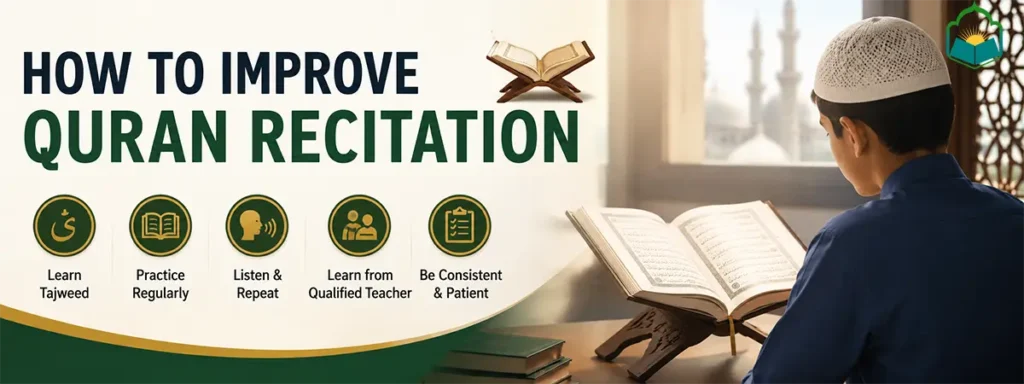
How to Improve Quran Recitation: A Step-by-Step Tajweed Guide to Read with Confidence and Clarity
Learning how to improve Quran recitation is one of the most meaningful goals a Muslim can pursue, whether you are a complete beginner or someone refining years of practice. At Ibadah Quran Academy, we work with students across the UK, USA, Canada, and Pakistan who share the same goal: reciting the Quran with clarity, correct Tajweed, and heartfelt connection. Poor pronunciation, inconsistent practice, and a lack of structured feedback are the most common reasons progress stalls, and this guide walks through exactly how to fix that.
This guide covers the full path to Quranic fluency, from mastering Makharij and Harakat to building breath control and voice confidence. You will learn the most common Quran recitation mistakes, what a genuinely effective recitation program looks like, and how consistent practice with a certified Tajweed teacher turns hesitant reading into fluent, correct recitation. By the end, you will have a clear, practical plan to start improving today.
Understanding What Improves Quran Recitation: Tajweed, Makharij, and Fluency Explained
Before practicing, it helps to understand what actually drives Quran recitation improvement. Three elements matter most: Tajweed rules, which govern how each letter should sound; Makharij pronunciation, the exact articulation points in Arabic where letters originate; and Harakat, the short vowels that shape rhythm and meaning. Together, these form the technical foundation of correct Quran recitation. Skipping any one of them creates gaps that show up later as recurring mistakes. Students who understand the reasoning behind each rule, rather than memorizing rules blindly, tend to retain proper Tajweed far more naturally and recite with genuine confidence rather than guesswork.
What Is Tajweed and Why Does It Matter for Correct Recitation?
Tajweed is the set of rules that govern how Quranic Arabic should be pronounced, including letter length, nasalization, and emphasis. Without it, meaning can shift entirely, even when the letters look identical on the page. Learning Tajweed rules is not about perfectionism; it is about honoring the text as it was revealed. Most students find that once they grasp a handful of core rules, reciting Quran correctly becomes far less intimidating within a few weeks of guided practice.
Makharij and Articulation Points: The Foundation of Proper Pronunciation
Makharij pronunciation refers to the precise articulation points in Arabic, the exact spot in the throat, tongue, or lips where each letter is produced. Arabic has several letters with no English equivalent, so self-taught readers often blur sounds that should be distinct. Practicing Makharij correctly with a teacher who can hear subtle errors is the fastest way to fix Arabic letter pronunciation issues that have gone unnoticed for years.
Harakat and Short Vowels: Mastering the Building Blocks of Arabic Sounds
Harakat in Arabic, the small marks above and below letters, control short vowels in Arabic and directly affect rhythm, tense, and meaning. Beginners often rush past them, but the Noorani Qaida Course places heavy emphasis on vowel accuracy for exactly this reason. Slowing down to master Harakat early prevents a habit of rushed, unclear reading that becomes harder to correct later.
Proven Techniques to Improve Quran Recitation Step by Step
Once the fundamentals are clear, the next step is to improve recitation with Tajweed through consistent, structured practice rather than sporadic effort. The most effective Quran recitation training combines three habits: listening to and repeating Quran recitation from a qualified reciter, practicing Makharij out loud rather than silently, and reading Quran slowly and clearly before attempting speed. Recitation is a physical skill as much as a knowledge one, so muscle memory in the tongue and jaw develops only through repetition. Students who practice daily, even for ten focused minutes, generally progress faster than those who study Tajweed theory without applying it aloud.
How to Practice Makharij and Correct Arabic Letter Pronunciation Daily
Set aside a few minutes each day to isolate difficult letters rather than reciting entire passages. Mastering Arabic pronunciation works best in small, repeated drills, comparing your sound to a teacher’s or a trusted reciter’s audio. Recording yourself and listening back reveals errors the ear misses in the moment, making practicing Makharij correctly a daily habit rather than an occasional correction.
Listening and Repetition: Building Quranic Fluency Through Guided Practice
Quranic fluency grows through repeated exposure to correct recitation, not through reading alone. Listening and repeating Quran recitation trains the ear to recognize proper rhythm and pronunciation before the tongue can reproduce it accurately. Pairing this with recitation practice with a teacher ensures mistakes are caught immediately, rather than reinforced through weeks of unsupervised repetition.
Breath Control and Voice Training for Smooth, Melodic Recitation
Breath control in recitation allows longer verses to be read smoothly without gasping mid-ayah, which also improves melodic recitation techniques over time. Simple exercises, such as practicing long exhales while reciting extended vowels, build the stamina needed for fluent reading. Combined with basic Quran voice training, this creates recitation that sounds calm, clear, and confident rather than rushed.
Common Quran Recitation Mistakes and How to Fix Them
Even dedicated students repeat the same common Quran recitation mistakes for years simply because no one has pointed them out. The most frequent issues include merging similar-sounding letters, ignoring elongation rules, and reciting too quickly to apply Tajweed accurately. Avoiding mistakes in Quran recitation starts with honest, ongoing feedback rather than self-assessment, since it is genuinely difficult to hear your own pronunciation errors. This is one of the strongest arguments for structured lessons over self-study routes, particularly for beginners still building foundational habits.
Why Beginners Struggle with Tajweed Rules and Makharij
Most beginners struggle not from lack of effort but from learning Tajweed as abstract rules rather than practiced sounds. Without a teacher correcting pronunciation in real time, small errors become habits that are far harder to unlearn later. This is why Quran reading for beginners should always pair rule explanation with immediate, spoken practice and correction.
How a Certified Tajweed Teacher Corrects Recitation Errors in Real Time
A certified Tajweed teacher listens for the specific letters and rules a student consistently misses and adjusts lessons accordingly, rather than following a rigid script. Real-time correction, whether in person or through live online classes, shortens the gap between making a mistake and fixing it, which is exactly how lasting improvement happens.
Signs You Need Structured Noorani Qaida or Tajweed Training
If recitation still feels hesitant after months of independent practice, or the same letters consistently sound unclear, it is usually a sign that foundational Noorani Qaida training was skipped or rushed. Returning to structured basics, even as an adult, often resolves recurring issues faster than continuing to practice advanced surahs without correcting the root cause.
What to Look for in a Quran Recitation Program That Actually Works
Understanding how to improve Quran recitation also means knowing what a genuinely supportive program looks like, since technique alone rarely sticks without the right structure around it. Not every Quran recitation training option delivers the same results. Certified instructors, individualized attention, and measurable progress tracking consistently separate strong programs from generic ones. At Ibadah Quran Academy, our approach centers on one-on-one sessions built around each student’s specific pronunciation gaps rather than a fixed, identical curriculum for everyone. Below is a quick comparison of what to expect from an unstructured approach versus a properly guided one.
| Learning Factor | Unstructured Self-Study | Guided Program with a Certified Teacher |
| Pronunciation Correction | Relies on self-assessment; errors often go unnoticed | Corrected in real time by a certified Tajweed teacher |
| Progress Tracking | Informal and inconsistent | Recorded assessments show measurable improvement |
| Learning Pace | Fixed by whatever resource is being used | Personalized to the student’s specific gaps |
| Feedback Speed | Delayed or absent | Immediate, session-by-session correction |
| Long-Term Retention | Habits and errors can become fixed | Consistent correction supports lasting accuracy |
Certified Teachers and Verified Ijazah Credentials: Why Qualifications Matter
An Ijazah, a formal certification of authorized transmission, confirms that a teacher’s own recitation has been verified by a qualified chain of instructors. Learning from a certified Tajweed teacher with verified credentials means corrections are grounded in authenticated knowledge, not guesswork, which matters enormously when the goal is correct Quran recitation rather than approximate reading.
Personalized Learning Plans vs One-Size-Fits-All Recitation Classes
Every student carries different pronunciation habits shaped by their native language and prior exposure to Arabic. A personalized plan targets exactly those gaps, while generic group classes often move at a fixed pace regardless of individual need. This is one of the clearest predictors of how quickly Quran recitation improvement actually happens.
How Progress Tracking and Assessment Keep Recitation Improvement on Track
Regular, recorded assessments show whether corrections are actually sticking or simply repeated in the moment and forgotten. Structured progress tracking gives both student and teacher a clear picture of which rules need more focus, turning recitation practice into a measurable, steadily improving process.
How Students Stay Motivated and Consistent While Improving Their Recitation
Technical knowledge alone rarely sustains long-term improvement; consistency and encouragement matter just as much. Students, especially children, progress fastest when practice feels supportive rather than stressful, and when parents can see tangible evidence of growth. Building confidence in recitation often matters more in the early months than technical perfection, since a hesitant reader who keeps practicing improves faster than a discouraged one who stops. A steady, encouraging structure, rather than pressure, is what keeps students returning to their Quran recitation practice week after week.
Parent Involvement and Feedback in a Child’s Recitation Journey
Parents do not need to know Tajweed themselves to support their child’s progress meaningfully. Regular updates from a teacher, along with visible milestones, help parents reinforce practice at home and celebrate small wins. This involvement consistently correlates with stronger, more consistent Quran recitation improvement in younger learners.
Safety Standards and One-on-One Learning Environments Parents Trust
For online learning, verified teacher backgrounds, monitored sessions, and clear communication channels give parents confidence in their child’s learning environment. A one-on-one setting also means every minute of the lesson is focused entirely on that student’s recitation, rather than shared across a group.
Long-Term Results: What Consistent Practice with a Qualified Teacher Achieves
Students who practice consistently over several months typically move from hesitant, letter-by-letter reading to smooth, confident recitation with correct Tajweed applied naturally rather than consciously. This shift, from effortful to intuitive, is the clearest long-term marker that Quran recitation training is working.
Start Improving Your Quran Recitation Today with a Free Trial Class
If you have been searching for how to improve Quran recitation and want personal guidance rather than another generic checklist, the fastest next step is simply to start with a qualified teacher. At Ibadah Quran Academy, our free trial class lets you experience a real lesson, meet a certified Tajweed teacher, and get an honest assessment of where to focus first, with no pressure to continue if it is not the right fit. Enrollment is straightforward, scheduling is flexible across UK, USA, Canada, and Pakistan time zones, and every plan is built around your specific goals rather than a generic template.
How to Enroll with Confidence in a Structured Tajweed Program
Enrollment begins with a short conversation about current recitation level and goals, followed by a placement assessment so lessons start at the right point rather than the beginning for everyone. There is no long-term commitment required before the free trial, making it a low-risk way to evaluate fit before deciding on a full program.
Choosing the Right Recitation Course for Your Age, Level, and Goals
Whether the goal is basic Quran reading for beginners, correcting specific Tajweed habits, or working toward Ijazah-level mastery, course pacing should match that goal directly. A brief placement conversation before enrollment ensures your course and your teacher are matched to where you are starting from.
Book Your Free Trial Class and Meet a Certified Tajweed Teacher
Booking a free trial class takes a few minutes and puts you directly in a live session with a certified Tajweed teacher, not a recorded lesson. It is the clearest way to see, in a single session, exactly how personalized correction and structured practice can move your recitation forward.
How to recite Quran for beginners?
Beginners should start with Noorani Qaida to learn Arabic letters and Harakat before attempting full verses. Practicing slowly with a teacher who corrects Makharij pronunciation early prevents mistakes from becoming habits, making the transition to full Quran recitation far smoother.
How to recite Quran beautifully?
Beautiful recitation combines correct Tajweed rules, steady breath control in recitation, and natural rhythm rather than forced melody. Listening closely to skilled reciters and practicing melodic recitation techniques consistently helps develop a clear, pleasant recitation voice over time.
How to recite Quran fluently?
Quranic fluency develops through daily, repeated practice rather than occasional long sessions. Listening and repeating Quran recitation builds automatic recognition of letters and rules, so reading eventually flows naturally without pausing to consciously apply each rule.
How to improve recitation skills?
Improving recitation skills requires structured Quran recitation training, consistent daily practice, and feedback from a certified Tajweed teacher who can catch errors you cannot hear yourself. Progress tracking helps confirm which specific rules need continued focus.
What are the 7 rules of Tajweed?
The core Tajweed rules cover Makharij (articulation points), Sifaat (letter characteristics), Ghunnah (nasalization), Madd (elongation), Qalqalah (echoing sound), Idgham (merging letters), and Ikhfa (concealment). A qualified teacher applies these together during live recitation correction.