
Tajweed Rules for Beginners: A Simple, Step-by-Step Guide to Correct Quran Recitation
Learning to recite the Quran correctly begins with one essential foundation: Tajweed rules for beginners. Whether you are a parent searching for guidance for your child, an adult revert exploring the Quran for the first time, or a student who wants to correct years of mispronunciation, understanding the basic Tajweed rules for beginners is the starting point for every confident reciter. At Ibadah Quran Academy, we see students of all ages ask the same question: Where do I even begin?
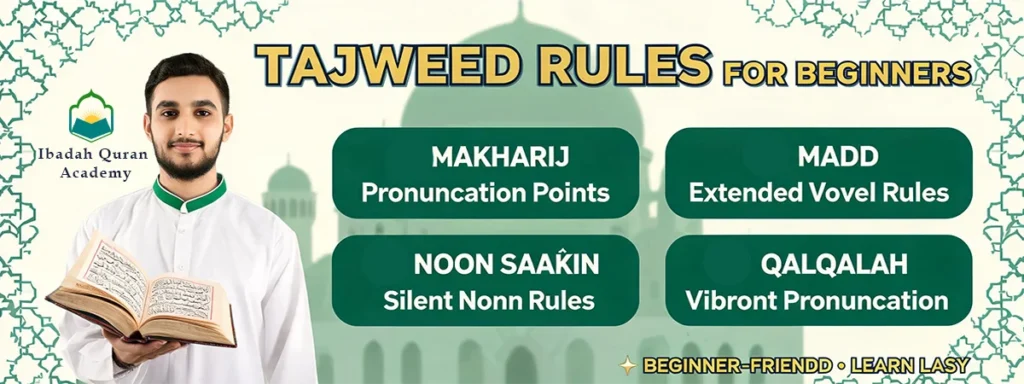
This guide breaks these rules into simple, practical steps. You will find beginner Tajweed rules explained in plain English, alongside a simple approach for new learners that avoids overwhelming jargon. From Makharij and Noon Sakinah to Madd and Qalqalah, this step-by-step roadmap covers everything a beginner needs to recite the Quran with accuracy, confidence, and reward. It also addresses the practical concerns families raise most often, including how long the process realistically takes, how progress is tracked, and what to look for before choosing a teacher or program.
What Are Tajweed Rules and Why Do Beginners Need Them?
Tajweed exists to protect the meaning and beauty of Quranic recitation. Without correct application, letters can be mispronounced in ways that change meaning entirely, which is why every learner benefits from a structured, step-by-step introduction to these principles.
What Are the Basic Tajweed Rules for Beginners?
The basic Tajweed rules for beginners cover three core areas: correct pronunciation of Arabic letters, the characteristics of each letter, and the rules that govern how letters interact when placed next to one another. Beginners typically start with Makharij, move on to Noon Sakinah and Tanween rules, and then progress to the Madd rules. This gradual sequence prevents confusion and builds a strong foundation for accurate recitation over time.
How Tajweed Improves Quran Recitation Accuracy and Reward
Correct application of these rules directly affects how accurately the Quran is recited. Scholars have long emphasized that reciting with proper articulation preserves the intended meaning of each verse. For example, mixing up a heavy letter with a light one can completely change a word. Therefore, learning Tajweed is not simply a technical exercise; it is an act of care and respect for the text itself and reflects the seriousness a student brings to their recitation practice.
Can You Learn Tajweed Without Prior Arabic Knowledge?
Many new learners assume that Tajweed fundamentals for non-Arabic speakers require years of language study first. In reality, Tajweed Quran for non-native Arabic speakers is taught largely through sound, repetition, and visual guides rather than grammar. A student can begin practicing correct pronunciation from the very first lesson, even without reading or writing Arabic fluently, since the ear often learns faster than the eye.
The Essential Tajweed Rules Every Beginner Must Master
Once the basics are understood, learners move into the essential rules that form the backbone of correct recitation. These include articulation points, letter characteristics, and the rules that shape how sounds flow together across a verse.
Makharij: Points of Articulation for Correct Letter Pronunciation
Makharij, or the Makharij of Arabic letters, refers to the exact point in the mouth or throat where each letter originates. Arabic letter pronunciation depends entirely on getting these points right, since two letters that sound similar to an untrained ear often come from completely different places in the mouth. In addition, Sifaat, the characteristics of letters, describes qualities such as heaviness, lightness, and airflow. Together, Tafkheem and Tarqeeq, or heavy versus light letters, shape how a reciter’s voice should rise or soften on specific sounds, and mastering this contrast is often the clearest sign of real progress.
Noon Sakinah and Tanween Rules (Izhar, Idgham, Iqlab, Ikhfa)
The Noon Sakinah and Tanween rules govern what happens when a silent Noon or Tanween meets the next letter in a word or phrase. There are four possible outcomes: Izhar, Idgham, Iqlab, and Ikhfa, and each one changes how clearly or softly the sound is pronounced. Ghunnah, the nasal sound, plays a central role in several of these rules and is often the hardest skill for new learners to master through listening alone, which is why guided practice matters early on.
Meem Sakinah, Qalqalah, and Madd Rules Explained Simply
Meem Sakinah rules work similarly to Noon Sakinah but apply specifically to a silent Meem within a word. Qalqalah letters, remembered through the five letters ق ط ب ج د, produce a small echoing bounce when they carry a sukoon at the end of a word or phrase. Madd rules, including Madd Asli and Madd Far’i, control how long a vowel sound is elongated, and getting the timing right is one of the most common challenges for reciters who are just starting.
How to Practice Tajweed at Home: A Beginner-Friendly Routine
Consistent home practice turns theory into habit. A simple, repeatable routine helps beginners retain what they learn in class and builds the muscle memory needed for fluent, confident recitation over time.
Using a Color-Coded Tajweed Mushaf to Learn Faster
A color-coded Tajweed Quran assigns a distinct color to each rule, so learners can visually recognize Madd, Ghunnah, or Qalqalah at a glance while reading. A Tajweed Mushaf with signs removes the guesswork of memorizing rules in isolation, letting students see each rule applied directly within the verse they are reading rather than as an abstract concept on a whiteboard.
Listen-and-Repeat Practice with Short Surahs and Juz Amma
Short Surahs, particularly within Juz Amma, give beginners manageable text to apply new rules without feeling overwhelmed by length. Listening to a qualified reciter and repeating the same verse aloud trains the ear before the tongue fully catches up. For example, recording yourself and comparing it against a teacher’s recitation reveals small gaps that are easy to miss when relying on memory alone.
Common Mistakes Beginners Make (and How to Fix Them)
The most common mistakes at this stage include rushing through Madd letters, skipping Ghunnah entirely, and confusing similar-sounding letters under pressure. A steady daily routine, built around short drills of even ten minutes, corrects these habits far faster than occasional long sessions spread weeks apart.
Learning Tajweed Alone vs. Learning with a Certified Tutor
Self-study has its place, but structured feedback accelerates progress considerably. This section compares independent learning with guided instruction from a qualified teacher.
Why a Qualified Tajweed Teacher Accelerates Correct Pronunciation
A certified Private Quran tutor can hear subtle pronunciation errors that a beginner may not notice in their own recitation, particularly around Makharij and Sifaat. Because self-correction has natural limits, real-time feedback from an experienced instructor shortens the learning curve significantly and prevents small errors from becoming long-term habits.
How Progress Monitoring and Feedback Prevent Bad Habits
Regular progress monitoring catches small errors before they become permanent habits. At Ibadah Quran Academy, we track each student’s recitation session by session, so parents and learners can see measurable improvement rather than guessing at how a course is actually going. Parent involvement matters here too, since a short weekly summary of what was covered helps families reinforce lessons at home instead of relying on memory of what happened in class. A clear assessment process, revisited every few weeks, also gives both the teacher and the family an honest picture of which rules still need extra attention.
Is Online Learning Effective for Adults and Kids?
Online classes for beginners work well for both age groups when lessons are paced appropriately for the learner. Younger children often respond well to games, colors, and repetition, while adult beginners tend to benefit from structured explanation and direct correction, tailored to their pace and any prior exposure to Arabic. For families choosing an online setting for a child, safety measures such as one-on-one supervised sessions, verified teacher identities, and parent-visible scheduling all matter as much as the teaching method itself and are worth asking about before enrolling.
Choosing the Right Tajweed Program for Your Learning Goals
With so many options available, selecting the right course matters as much as the content itself. The following considerations help learners and parents make a confident, informed decision before enrolling.
How Long Does It Take to Learn Tajweed as a Beginner?
Most learners grasp the core rules within a few months of consistent practice, though genuine fluency continues to develop over a longer period through ongoing revision. Regular revision remains important even after the initial rules are learned, since consistency is what preserves accuracy over the years that follow.
Start Learning with a Free Trial Class Today
Understanding how to learn Tajweed as a beginner is easier with guided support from day one. At Ibadah Quran Academy, we offer a free trial class so new students can practice simple, structured Tajweed rules for beginners before committing to a full program, with no pressure and no obligation.
Self-Study vs. Guided Learning: A Quick Comparison
| Factor | Self-Study | Guided Learning with a Tutor |
| Pronunciation correction | Relies on self-assessment | Real-time correction from a certified teacher |
| Progress tracking | Informal, easy to lose track of | Structured, session-by-session monitoring |
| Pace | Fully flexible, but easy to stall | Flexible with built-in accountability |
| Best suited for | Reinforcing rules already learned | Beginners learning rules for the first time |
Conclusion
Mastering Tajweed rules for beginners is a gradual process built on correct pronunciation, consistent practice, and reliable feedback. From Makharij and Noon Sakinah rules to Madd and daily drills, each step brings a learner closer to confident, accurate Quran recitation. Progress is rarely linear; most students notice a plateau at some point, and this is usually a sign that revision is needed rather than a reason to stop. With the right structure, honest progress tracking, and steady support, perfect recitation becomes an achievable goal rather than a distant one, regardless of whether a learner starts as a young child, a busy adult, or someone returning to the Quran after years away from regular practice.
How can I learn Tajweed without a teacher?
Self-study is possible using a color-coded Mushaf, audio recitations, and slow repetition, though progress is usually slower and mistakes are harder to catch without outside feedback.
How can I learn Tajweed without a teacher?
Start with Makharij and letter characteristics, then move through Noon Sakinah, Meem Sakinah, and Madd rules in order, practicing each with short Surahs before adding the next.
Can the Quran be read without Tajweed?
The Quran can technically be read without Tajweed, but doing so risks mispronouncing letters in ways that can change the meaning of a word or verse.
Which Tajweed rules should I learn first?
Most learners begin with Makharij and Sifaat, since correct letter pronunciation is the foundation upon which every other rule, including Noon Sakinah and Madd, builds.
How to start learning Tajweed from zero?
Begin with the Arabic alphabet and articulation points, then progress gradually to Noon Sakinah, Meem Sakinah, and Madd rules with consistent short practice sessions.