
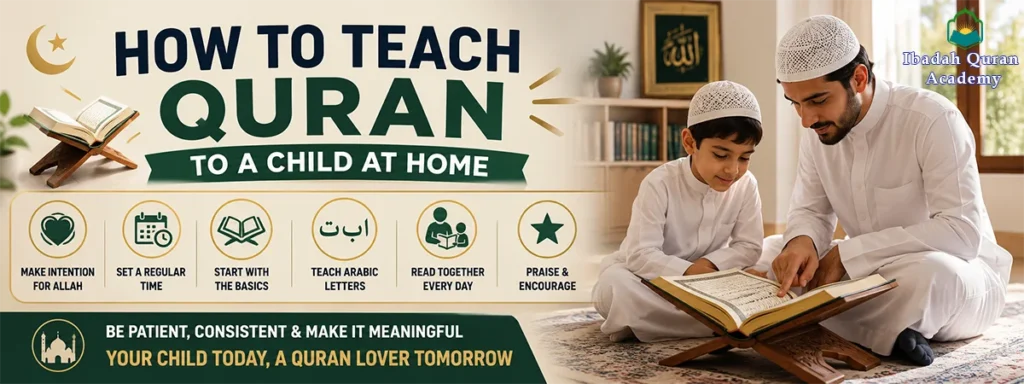
How to Teach Quran to a Child at Home: A Practical, Step-by-Step Parent’s Guide
Learning how to teach Quran to a child at home can feel overwhelming when you don’t know where to start. Many parents want to teach Quran to children at home but worry about their own limited Arabic or Tajweed knowledge. The good news is that with the right structure, love, and patience, any parent can begin teaching Quran to children at home confidently.
This guide walks you through a practical method to teach kids Quran at home, covering everything from choosing the right age to start to building a daily habit. Whether you are just beginning Quran learning for kids at home or looking to improve an existing routine, you’ll find clear, honest, and actionable steps below — including Quran lessons for children at home that actually work for busy families.
1 — Understanding How to Teach Quran to a Child at Home Successfully
Before diving into lessons, it helps to understand the foundation. Successful home Quran teaching for kids depends less on perfect Arabic and more on consistency, patience, and the right expectations. Getting this stage right prevents frustration later and sets both parent and child up for long-term success.
What Age Should You Start Teaching Quran at Home?
Most scholars and educators agree that early Quran education can begin as early as age 3–4 with simple recognition of letters and sounds. For example, toddlers can learn short surahs through repetition and rhythm before they even understand meaning. However, formal reading (Noorani Qaida) usually starts around age 5–6, when attention span improves.
What Every Parent Needs Before Starting Quran Lessons at Home
You don’t need to be a scholar to begin. A copy of the Quran or Qaida, a quiet corner, 10–15 minutes daily, and a calm attitude are enough. In addition, having access to Noorani Qaida online classes at home as a backup resource can help correct pronunciation you’re unsure about.
Common Mistakes Parents Make When Teaching Quran at Home
Many parents push too hard, too fast, expecting fluency within weeks. Others skip correction, letting mispronunciation become a habit. Therefore, the goal should always be steady, unforced progress rather than speed.
2 — Step-by-Step: How to Teach Quran to a Child at Home
Once the basics are in place, a simple, repeatable method makes all the difference. This step-by-step approach to teaching a child Quran at home removes guesswork and builds real confidence over time.
How to Teach Short Surahs to Kids First
Start with short surahs for kids like Al-Fatiha, Al-Ikhlas, and Al-Falaq. Break each surah into small phrases, repeat them together, and use hand gestures or rhythm to help memory. For example, clapping along to syllables makes recitation feel like a game rather than a task.
How to Build a Daily Quran Schedule Children Actually Follow
Consistency beats intensity. A Quran learning routine for children of just 10–15 minutes at the same time daily, such as after Fajr or before bed, builds a habit faster than long, irregular sessions. Keep a simple visual chart so your child can see their daily Quran practice for kids’ progress.
How to Help a Child Memorize Quran at Home Without Pressure
Use the “little and often” method: recite a line, have the child repeat it five times, then move on. Review the previous lines the next day before adding new ones. This gentle repetition supports Quran memorization for kids without turning it into a stressful chore.
3 — Making Quran Learning Fun and Age-Appropriate
Children learn best when lessons feel enjoyable rather than obligatory. Building genuine love for the Quran early on creates learners who want to continue, not ones who feel forced.
How to Make Quran Learning Fun for Children
Turn lessons into stories. Explain the context behind a surah in simple language, use colorful charts, or reward small milestones with stickers. This is one of the simplest ways to make Quran learning fun while keeping it meaningful.
Engaging Quran Activities That Build Love for the Quran
Try fun Quran activities for children such as tracing Arabic letters, matching games, or family recitation circles. In addition, letting children “teach” a younger sibling a surah they’ve memorized boosts confidence and retention.
How to Teach the Meaning of the Quran to Kids, Not Just Recitation
Recitation alone isn’t enough. After a surah is memorized, explain its meaning in a sentence or two using everyday language. For example, explaining that Al-Ikhlas describes Allah’s oneness helps children connect emotionally, not just mechanically.
4 — When Parent-Led Teaching Isn’t Enough: Recognizing the Limits
Honest parents eventually notice a ceiling. Recognizing this early — rather than letting mistakes go uncorrected — protects your child’s long-term Quran journey.
How to Teach Tajweed to Children at Home (And When You Need a Teacher)
Basic Tajweed rules, like stretching letters correctly, can be introduced at home using audio recitations from qualified reciters as a model. However, Tajweed for children requires live correction of mouth position and pronunciation, which is difficult to self-teach accurately.
Signs Your Child Needs Guided Support Beyond Home Teaching
If your child repeats the same mistakes despite correction, loses motivation, or you feel unsure about your own pronunciation, these are signs it’s time for outside guidance. This doesn’t mean home teaching failed — it means your child is ready for the next stage.
Is Parent-Led Quran Teaching Enough for Long-Term Progress?
Parent-led Quran learning is an excellent foundation, but long-term Tajweed accuracy and structured Hifz progress usually benefit from a qualified teacher’s ear. Combining both gives the most balanced outcome.
5 — Staying Consistent: Building a Lifelong Quran Habit at Home
A habit that lasts matters more than a perfect method. This section focuses on keeping momentum long after the initial motivation fades.
How to Build a Quran Habit in Children That Actually Sticks
Anchor the habit to an existing routine, such as right after breakfast. A consistent Quran learning routine built around an existing habit is far more sustainable than trying to find “extra” time each day.
How to Keep Children Motivated When Progress Feels Slow
Celebrate small wins — a correctly recited line, a memorized ayah — rather than only big milestones. In addition, involving the whole family in short recitation sessions helps normalize the habit rather than isolating the child.
Tracking Progress: How to Know Your Child Is Really Learning
Keep a simple log of surahs learned and revision dates. If your child can recite a surah after a week without prompting, that’s genuine retention rather than short-term memorization.
6 — Get Expert Support: Combine Home Teaching with Guided Quran Classes
Home teaching and guided instruction work best together, not as competing methods. This final stage shows how to responsibly extend what you’ve already built at home.
How Guided Online Classes Support What You Teach at Home
A qualified teacher reinforces correct Tajweed, corrects small errors early, and keeps a structured Hifz plan — while you continue nurturing daily habits at home. This combination gives children both child-friendly Quran lessons and expert accuracy.
What to Expect from a Free Trial Class for Your Child
A typical free trial class involves a short pronunciation assessment, a sample lesson, and a conversation about your child’s current level. It’s a low-risk way to see if guided lessons fit your family’s routine.
How to Enroll with Confidence and Keep Learning Consistent
Enrolling is simple. Just click on the Get Your Free Trial Classes Button and fill basic info.
Quick Reference Table: Home Teaching vs. Guided Classes
| Aspect | Parent-Led Home Teaching | Guided Online Classes |
|---|---|---|
| Best for | Building daily habit, love for Quran | Tajweed accuracy, structured Hifz |
| Correction level | Basic, self-taught | Live, expert correction |
| Flexibility | Fully flexible | Scheduled, but adaptable |
| Cost | Free | Paid (often with free trial) |
| Long-term outcome | Strong foundation | Certified, accurate progress |
Is it possible to learn the Quran online?
Yes. Many children and adults successfully learn Quran recitation, Tajweed, and memorization through structured online classes with qualified teachers, alongside home practice.
Which is the best online Quran learning?
The best option depends on your child’s age, goals, and teacher qualifications. Look for certified teachers, trial classes, transparent pricing, and flexible scheduling.
Can you learn the Quran effectively online?
Yes, especially when combined with consistent home practice. Live correction from a qualified teacher plus daily revision at home produces strong, lasting results.
How effective are online Quran classes?
Effectiveness depends on consistency, teacher quality, and parental involvement. Regular attendance combined with daily home revision typically produces the fastest, most reliable progress.